
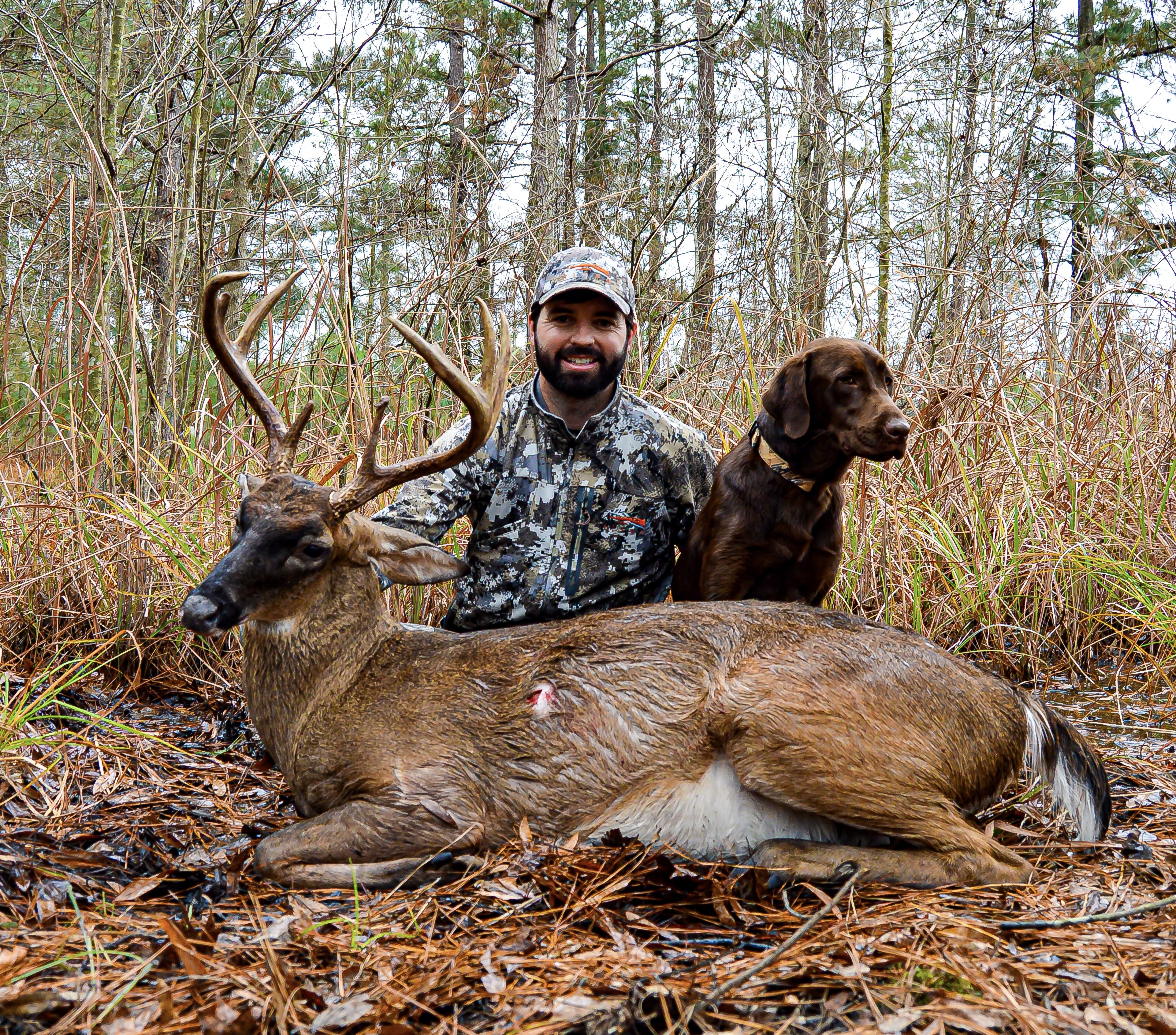
Some bucks evoke a pursuit. Not a deer that’s patterned or predictable to a food source, rather one that’ll take time and focus to fulfill. Those who don’t take the woods for game meat wouldn’t understand the challenge is mostly within the hunter. To bear down, remain focused and stick to the plan even when you want to give up.
There are bucks I hope I run into and others I pursue directly. The latter was the case for Black Buck. A melanistic whitetail with a distinctively dark head. An unmistakable appearance that motivated me for the hunt. Southern deer live but a short time. The average age for a buck varies by region and habitat, but bucks tend to live no more than 4-5 years. Whether shot, disease, health, or natural mortality it’s a quick lifespan. This was a buck I went after once he matured.
I first saw the buck in 2015 while hunting a drainage ditch running between a pine block and dense hardwoods. He worked the edge like many deer will during early morning light with no immediate rush to bed down. The sun had not peaked into the pines yet, but his dark complexion had a boldly sharp contrast to a tight, golden antler set. A basket 8 with height and a long slender frame ready for the upcoming breeding season. A buck you hope to see again but with another year of age.
The following summer of 2016, the same buck was captured on a pinewoods water hole trail camera. Despite the twilight hour black & white photo, his dark mask was undeniable. My favorite time of year to view bucks is late summer / early fall. When they’re at full glory of weight and health. Freshly peeled and polished with summer fat still intact. That is the annual pinnacle of a buck and a time to admire management efforts. The photo capture confirmed not only his survival but my decision to hunt the buck exclusively. I knew his core area was the pinewoods and that’s where I wanted to take him. On a game trail using timber features, a climber and archery equipment.

I’ve always preferred a climber. Not a preset tree but one I would choose on the fly based on wind, immediate location and what I think deer should be doing at any given point within the fall. Just like permanent stands, you either see nothing or your covered up. Statistically, mobile hunters at my farm view more deer than permanent stands. Especially, stands that are hunted multiple times within a tight window. A climber allows better access to unpressured areas where deer hold up. I had ideas where Black Buck would bed but of course nothing definitive. What could go wrong? Easy kill during the rut, right?
This is what separates Southeastern hunters from our contemporaries in the Midwest. We don’t have true funnels and pinch points. Bedding and feed sites are not precise on aerial maps. Southern pineland is vast and it provides various habitats seamlessly: bedding, thickets, forage, and travel corridors. To hunt it is to know you’ll have a significant decrease in total available shot opportunities. With edges and historical game trails a hunter will better the odds.
After early doe hunts were through, I shifted focus to the darkened deer. At that point, it was mid-October and our bucks were fired up with testosterone and social behavior peaking. Rubs, signposts and scrapes frequently visited and early estrus scent in the pines. Does were not receptive yet and still annoyed by immature bucks bumping them. With an uptick in deer movement, the time was right to start the pursuit.
The last week of October I had my first encounter of the season. He was held up in a pine thicket within a large timber stand. He and a doe chased around the immediate area, pausing in openings for mere seconds. Available shots were ideal for my rifle at approximately 100 yards, but I chose a compound bow to hunt this buck. A decision I began to regret. Deer move from “point A to point B’ in pine country but the route will vary daily. Trails are generally prevalent and there’s no reason for deer to use one over the other besides perceived danger. The morning climb was eventful, but it could have ended at the skinning shed via a spent bullet. But at least I knew where he would be as that area was full of does and bedding thickets.
The second sighting of the season came a week later, about 75 yards from the first encounter. When climbing thinned and burned big timber pines, your vision can often be 360 degrees. Best practice is to keep your head on a swivel. That morning, I set up directly between two young pines thickets. Hoping to catch the buck moving between. While glancing over my shoulder, I spotted Black Buck and another cohort blazing through the woods with nose to the ground. They were running nearly neck and neck clearly tailing a hot doe. Maybe she initiated a chase. Unsure as I wasn’t keeping a good eye behind my shoulder all morning. A rifle would not have provided a shot opportunity as they only slowed to a trot. There was nothing I could have done differently other than my tree of choice which happens when mobile hunting. You either pick a killing tree or a viewing tree. The bucks were moving to another thicket. As mentioned before, deer move to defined areas but how they travel is anything but defined.
By mid-November frustration was well in place, but I accepted the idea Black Buck might not be hung in the skinning shed this season. I was fine with it. There’s an appreciation woodsmen have for known whitetails of legend. It goes back to early writings of Archibald Rutledge and others. Despite what some hunters jest, bucks have been named for a long time going back to the early 1900s and likely well before. It’s a much simpler method as opposed to, “the buck with the dark face” or “the 10pt buck with the spilt brow tines”. Names also instill a since of legend and lore that adds layers to our hunting culture.
Every year, Thanksgiving is spent at the farm with family. A nice time away to relax, hunt and eat well. This may have been the year we attempted to fry geese which ended up becoming jerky! The last hunt, Sunday morning, I climbed one of the best game trails I know of; a short corridor between two expansive thickets. Known for rut buck movement. About an hour after sunrise two does left the thicket I was closest to and eased towards me along the trail. They moved at a good pace which suggested a buck was likely behind. Sometimes a hunter knows a buck is showing up, while other times you want one to appear. There’s a difference. This moment, I knew. Approximately, 10 minutes later, just as the sun was cresting over the young pine thicket lighting the game trail, a mature buck stepped out. I’ll never forget the sight. Sunlight shined down on him from the rear. He stood at full glory with breath illuminated in the light on a 30-degree morning. Because of the angle, his body was not lit, only his profile. There seemed to be something different with the antlers. Was this Black Buck or another? I raised my binoculars to confirm it was him. Exactly where he needed to be and certainly would follow the two does, or so I thought.
Binoculars were down and my bow was up drawing back just as he jumped off the trail and busted into an adjacent low lying briar patch. Confusion set in as to why he didn’t take the trail. Why he didn’t follow suit. I didn’t see any other does that morning. Well, just as he appeared, he bolted off chasing a doe that was bedded in the briar patch. They cut north heading towards the location of the second sighting. My heart sank. I should have gone with my gut knowing it was him, but I like to see bucks before I take a shot. Whether to confirm identity, age, or demeanor, I like to view a buck through binoculars or a scope first. That was a hard lesson to learn, and I likely could have gotten off a shot if I went with my gut. I had no idea a doe was bedded right off the trail. One of the many challenges of pine country; whitetails can and will bed anywhere at any time.
December seemed to slip by with work, family, and social obligations. I felt my opportunity to pursue the dark faced buck had passed so I shifted back into doe management. Targeting high concentration areas and with my bow. The rain-soaked morning of December 28th, 2016, I climbed along a natural spring creek running between pines and a cattail bottom. A high traffic site for doe groups and an ideal bow setup as my line of sight was 50 yards max either direction along the creek. After a lone button buck milled through, I figured does would be moving at any point.
About 7:30 am, the unmistakable pace of a deer walking close by erupted. There he was, Black Buck, easing down the creek. Because of the tight window, He was crossing by instantly and close. I saw my opportunity with a wide pine branch that would mask my movement once he was under. I would then raise my bow, draw back, and wait for his vitals to reappear after clearing the obstruction. He must have heard movement or sensed danger. He hesitated under the pine limb. A complete stop while I’m at full draw. It seemed like eternity. He jumped back and bounded the direction he came pausing roughly 30 yards away, peering towards my direction. Without hesitation, I lifted my bow, pulled back, and placed my 30-yard pin. A hard strike and a low run that quickly slowed into a crash. It happened. A double lung arrow from my climber with four days left in the season. I probably spent an hour taking photos and admiring the buck and hunt that culminated a journey. I brought in my 1-year-old labrador to soak it in as well. The antler variation I noticed at Thanksgiving was a broken off G3 and part of a brow tine snapped. Some pass on broken racks. I view it as character and a testament to whitetails. Also, the better a doe: buck ratio is the more fighting will occur. Quality herd structure yields more broken tines.

I gained a considerable amount of herd movement knowledge and how they utilize my farm. The way bucks move during the rut and where doe groups hold up. I used the intel to fine tune future seasons and consistently see and shoot mature bucks through natural movement. I also learned that sometimes you just need to hunt. Pine country bucks can be targeted but you never know where they might be without defined travel routes. Stay focused and understand deer behavior as it shifts throughout the fall. A trophy isn’t a score; it’s a pursuit of game and the meat it yields.


Leave a Reply