
“The privilege of hunting is about as fine a heritage as we have, and it needs to be passed on unsullied from father to son” – Archibald Rutledge
Snacks, iPads, toys, blankets and a second pair of binoculars; there are many things to pack when taking young kids deer hunting. If you plan to position yourself in front of wild and skittish whitetails with a realistic chance of placing a bullet in the killzone, there are numerous factors to consider. The time afield is incomparable and it instills valuable life lessons that are not taught in schools. Teaching a kid how to handle themselves in the woods is one of the most rewarding practices a father can disseminate to his children.
Goals constantly change as one progresses as a hunter. Over time, woodsmen reach various stages through their life. From trigger happy to selective harvest to acting a mentor, the progression happens with most hunters. Introducing someone to the outdoors can come in many forms. I’ve hosted first time hunters from ages 7 – 65. Both men and women from diverse locations and backgrounds. Danielle, a 30 year old woman from Nashville, took her first deer from the ground while balancing the rifle on a tower stand ladder rung. Millie shot her first deer last December at the age of 7. The doe weighed almost twice as her. At 11, Lawton dropped his first deer; a 4.5yr old 10pt while sitting on his grandfather’s lap. Although those were some of the more memorable experiences at our farm, they pale in comparison to time spent with my own kids. Even though they are only 8 and 5 and not shooting yet.


My kids have tagged along with me off and on over the past 3 seasons. I didn’t know what to expect at first but I challenged myself to improve techniques to accomplish 6 goals:
1. Minimize time on the stand. With short attention spans I did not want to burn them out from hunting too long at such a young age. This tactic increased the need for stealth-like stand approaches and low impact vehicle traveling as walking long distances was not practical. It also required an assessment as to where exactly deer would be traveling since we took the stand about 1-1.5 hours prior to dusk.

2. Close range shots. The last situation I want is a long and uncertain track job. That is knowledge to be taught but at a later date. Whitetails are edgy and constantly moving which increases the likelihood of a bullet hitting a little off the mark at distances over 150 yards. An opportunity within 50-75 yards will provide a quick and lethal kill shot. A hit to the shoulder will drop a deer and a strike in the vitals will cause a jailbreak run lasting under 50 yards with a heavy volume of blood to trail.

3. Open air stands. We do not have completely sealed stands like Redneck Blinds. I have hunted in those and don’t care for the style but that’s just my preference. I want my kids to learn by sitting in stands with a wrapped blind material or a pop-up style ground blind. A roof and blind cover provides concealment but scent and noise must be accounted for during the hunt. Every clank, laugh or snack wrapper is costly. We’ve seen many whitetails bolt from noise. That’s a lesson similar to touching the stovetop. When the pursuit is hyped with energy and excitement, kids want to see deer and they will absolutely want you to shoot one!
4. Concentration on noise. This by far is the most arduous task. Silently and steadily walking in the woods takes focus but it will quickly become second nature. The learning curve is significant but you must start somewhere. There is nothing worse than walking with an adult hunter that’s loud and oblivious to their noise level. Once you’re in the stand every detail matters and that’s how it should be.

5. Tracking. As mentioned above, my goal is to place the bullet in the vitals or at least one shoulder. A 150 grain 7mag caliber works very well to drop a deer within 20 yards. Adrenaline and the will to survive is tremendously strong with whitetails especially with late season does. I’ve witnessed many bucks and does sprint long distances after taking a heart shot. Accurate shot placement yields voluminous quantities of blood. That is imperative to develop tracking techniques and it’s ideal to establish ethical shots. It’s my opinion that kids should understand life and death. Meat is nurishment and it doesn’t magically appear at grocery stores cut and wrapped. Sustainable resources on the landscape is key to human existence and either you’re a direct consumer or you’ll rely on a middleman process to handle killing for you. The 2020 “pandemic” certainly proved that we shouldn’t solely rely on retail stores. Lastly, tracking wounded game is generally glossed over with new hunters or not even covered at all. If you’re capable of killing a whitetail, then you should be well versed in blood trails.

6. Skinning. Some things you can’t sugarcoat. Another life lesson society should grasp and there’s no reason to hide the process. Deer yield approximately 40% deboned meat. Hides can be skinned for rugs. Organs can be saved for dogs or those that consume. Enlightenment is all how you present the process. Ease them in and you’ll be surprised. My son, Welles, is the hoseman at the skinning shed. He loves the job and handles it well as long as you’re wearing rubber boots!

Overall, make it fun. Kids may advance to pulling the trigger one day or they might lose interest. Either way, they’ll develop impactful life long lessons and understand the consequences of taking a life. My 8 year old daughter, Gwyn, doesn’t have an interest in killing but she thoroughly enjoys hunting with me and routinely requests venison burgers and tacos. Welles, who turns 5 the day before the season opener has evolved into quite the little woodsman. Out of nowhere, he began tracking blood trails early last year and was in full charge. From dragging out, to helping at the skinning shed, he’s evolved substantially. I don’t know what the future holds but they are building a solid foundation before taking the practice range. Meanwhile, the entire method has made me a better hunter and much more efficient. Don’t waste the formative years. It’s a father’s responsibility to pass down our hunting heritage and culture to the next generation. There might not be a more rewarding process of fatherhood than teaching your kids the pursuit of wild game.


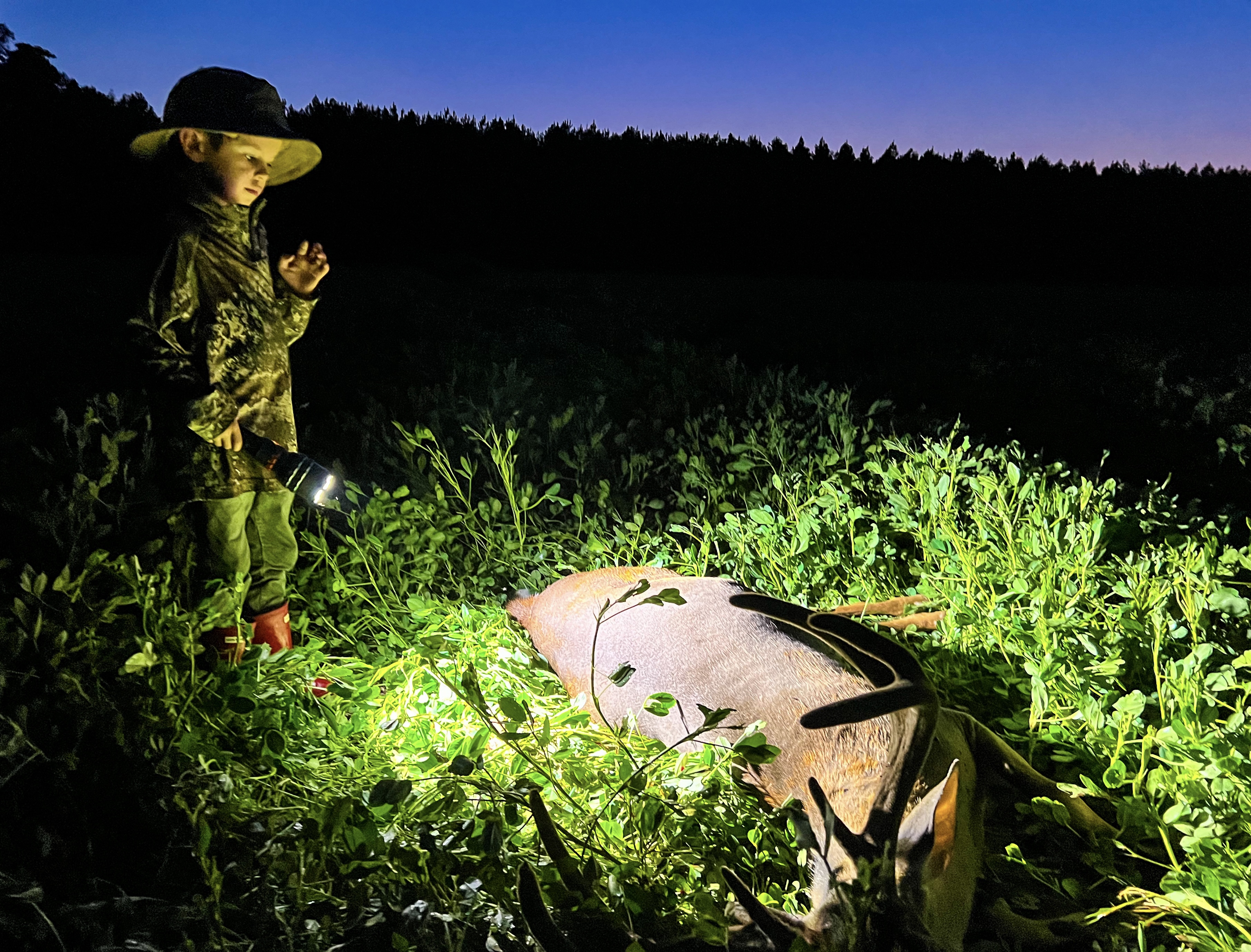
The art above was Welles’ Father’s Day gift to me. He painted it at school unbeknownst to me as I wrote this article June 2024. Two months later, 8/16/24, we hunted in a tower over peanuts as he painted. After does, fawns, yearlings, and immature bucks graced the field, the buck below stepped out with a couple minutes of light left. This was my first buck taken with a child and one of my finest memories afield.


Leave a Reply