
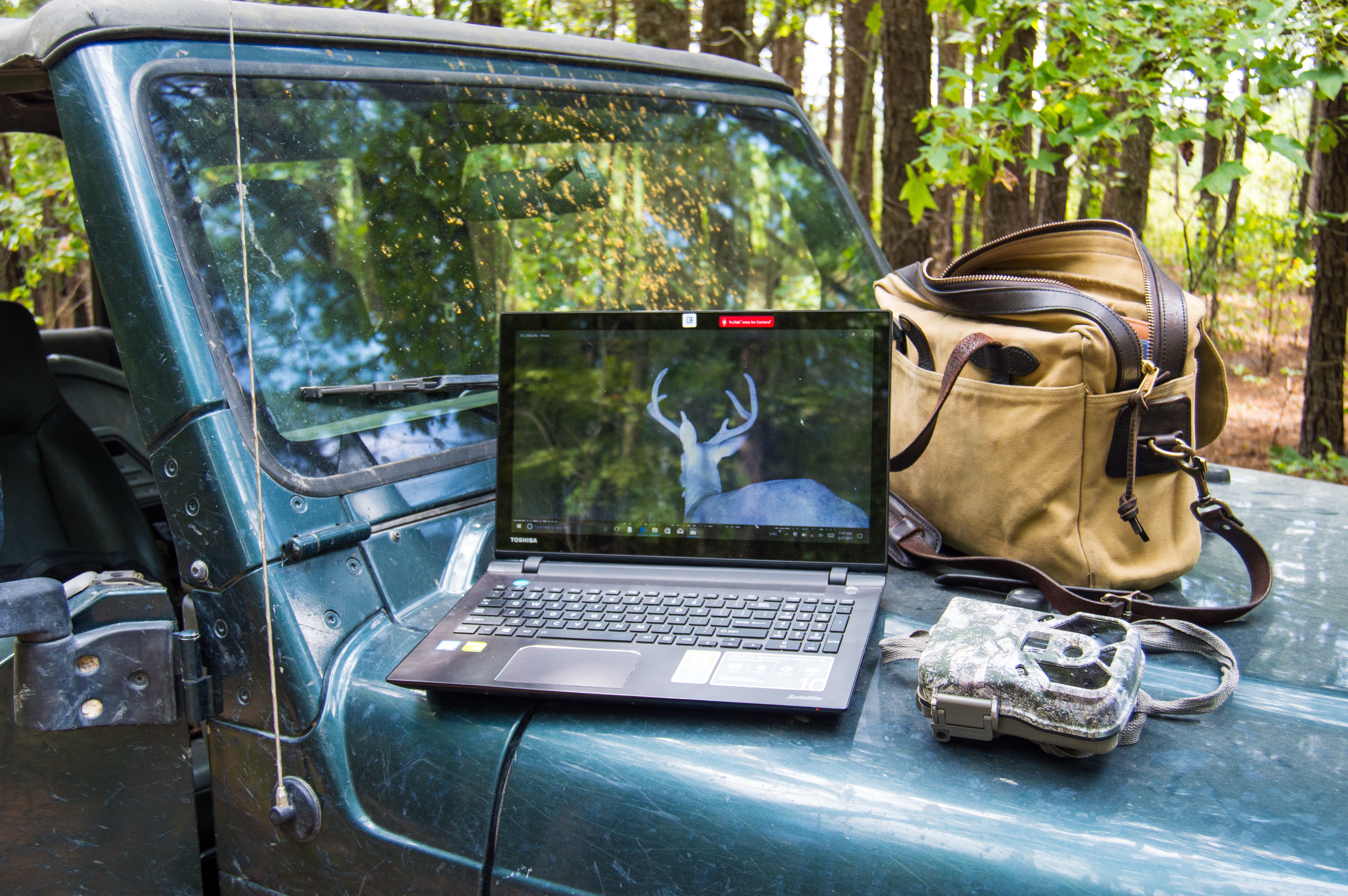
Monitoring the woods with surveillance is a relatively new tool for outdoorsman. It’s a game changer for hunters, deer managers and researchers. What we once didn’t believe or understand is now reality delivered via $100 cameras. Unmatched intel sent instantaneously. But are we truly capturing enough data to define real-time herd dynamics or is it one piece of the puzzle? Cameras can be utilized for both hunting and management practices simultaneously. Accurate recorded data not only improves chances to harvest bucks but it also ensures future cohorts to pursue season after season.
There are two types of camera location setups; passive and destination feed sites. Each has pros and cons. One is not better than the other as each offers unrivaled perspectives. It’s advantageous to diversify sites. Similar to hunting stands, you shouldn’t hunt only feed sites. You need stands on game trails and natural movement corridors. Whitetails are uniquely skittish and they avoid perceived danger every day of their life. It’s best to cover various landscapes and property features that deer utilize to maximize observations. Not merely one type.
Feed Sites
Destination food is the most efficient method to capture deer. Feeders, corn piles, mineral and salt blocks all work well. The tactic is highly effective for annual buck inventory, determining doe harvest numbers and fawn recruitment rate. Deer are essentially pulled into a set spot they wouldn’t normally be.

Herd monitoring surveys can be conducted on feed sites. Divide your property into 10+/- acre sections. Hang one camera in each section with a corn pile in front. Let it be for 7-10 days. I suggest at least 100lbs of corn per site. 50lbs will likely evaporate too quickly. 7-10 days will allow time for deer to find the corn and pull in potentially older, skeptical bucks. Once a site is completed, move the camera. After 3-4 weeks of rotations, you will collect the majority of your bucks and have a foundation as to your doe: buck ratio. This is best implemented early fall after velvet peels, antlers are polished, and ranges shift.

Prolonged usage of feed sites may result in a decrease of daylight movement. Deer often bed adjacent to these sites and can be easily educated from human presence. A feeder, mineral or salt block are ideal for long term camera stations. Higher capacity feeders minimize human traffic. Gravity fed units meet the need of every visiting deer but in high density regions, they are drained rapidly.
Passive Sites
Game trails, creek bottoms, water systems, travel corridors, and early successional communities are examples of passive setup locations. Any area that whitetails naturally pass through without manipulation. Less deer will be captured than a feed site but you’ll observe behavior in their natural element. Especially, within video mode.
All trails are not the same. Some are only used when food plots or fields are active with seasonal crop selections. Others are taken primarily during breeding season. While the best is what I call “historic game trails”. Those that are frequented daily by doe groups and heavily from antlered whitetails. Game trails become habitual when antlers are freshly polished leading to the last doe in estrus. Dots will be connected between signpost rubs and scrapes to doe bedding sites. The blueprint to filling buck tags is outlined with passive camera points.

A photographed buck every 2-3 weeks typically indicates it’s his core area fringe. Photos every 7-10 days should mean you’re in his kill zone. Timing of footage reveals much more prior to does entering estrus cycles. With daylight activity, he’s bedding close. Darkness signals he resides further away. Potentially, off your ground. At some point, a chess move is needed to record how tight you are to his bedding. Proximity intel is required proof to hunt the kings of the wilderness. I would push further up a trail from twilight photos and fan out additional cameras with infrequent bucks. Doe groups tend to routine defined routes moving from bedding to food. However, bucks will cover a wider path trekking from point A to point B. Particularly, pinelands and open bottomland. Thicker areas will likely have established paths of least resistance that bucks will select over blazing a new route. Whitetails are not lazy like some like to claim. Rather, they conserve energy and expend only when it’s imperative.
Too Much Stock in Photos?
“All of my deer have turned nocturnal”. “My shooter buck left my farm.” “No current photos, it must be the lockdown phase”. All hunter comments we hear annually! What is the basis of the statements – cameras covering a microscopic sliver of land and observations from a deer stand. We must understand cameras see very little of real-time herd activity. Whitetail behavior dramatically shifts during breeding season. The sole purpose of existence is just that, to remain in existence! Deer are focused on breeding and sidestepping threat. Hunter pressure is the leading cause of game disappearance from sight. They’re still close around and merely avoiding you. Deer transition to avoid predation. A survival trait perfected over millions of years. Cameras provide exceptional knowledge but are not indicative of overall herd behavior at any given time.
Quality Deer Management Benefits
Herd monitoring is one of the 4 cornerstones of QDM. Annual assessment of herd structure is vital to sustaining a healthy and balanced population. Through camera surveys, deer managers and hunters can run projections of the fawn recruitment rate, doe: buck ratio, density and buck age structure. Why guess when you can fine tune your management program with data-based strategies. Hard work and dedication should be confirmed through QDM observation practices.

Tips to Improve Camera Performance
- Wear rubber gloves and rubber boots during setup to minimize scent.
- Avoid visiting sites early morning and late afternoon. Pressure will disrupt movement patterns.
- Be conscious of wind direction and where your scent is blowing. Deer routinely bed beside feed sites. Bump one deer and it may create a domino effect.
- Let passive cameras soak for at least 2 weeks prior to relocation. The Southeast is dense and saturated with trails.
- Food plots and agricultural fields can be challenging to cover as every deer many not set the camera trigger. Find the predominant access point from the bedding side and fan out the trigger frame as needed.

Leave a Reply